
 العربية
 Español
 中文
中文 Deutsch
 Français
 Português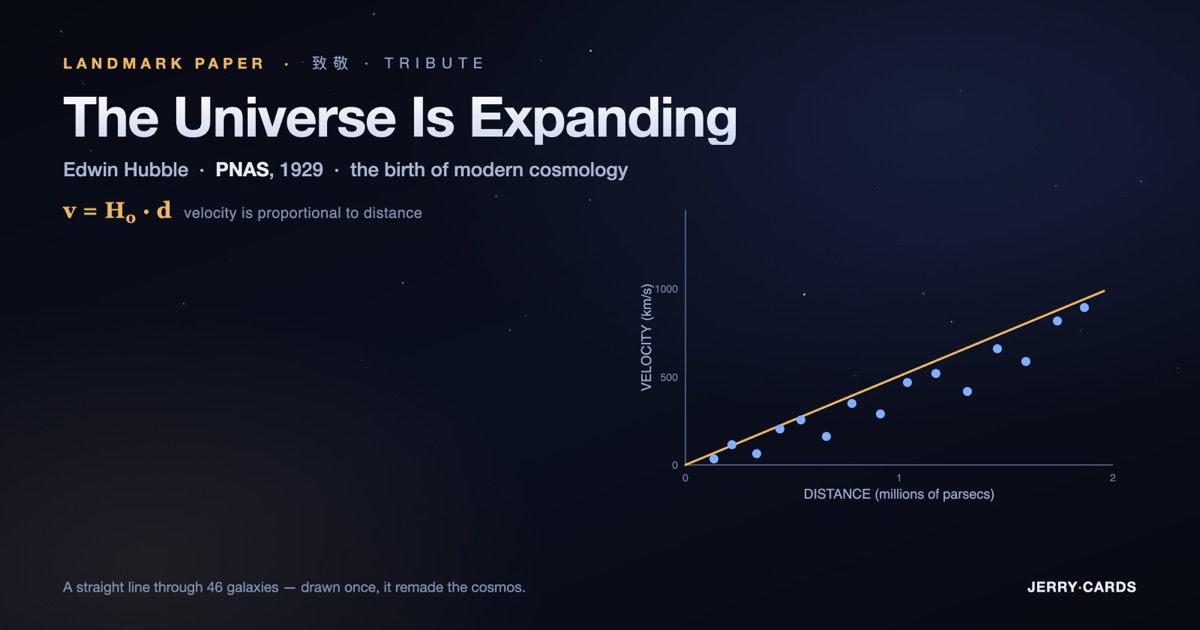
In the spring of 1929, an astronomer at Mount Wilson published six pages that quietly rewrote humanity’s address. Edwin Hubble’s paper in the Proceedings of the National Academy of Sciences carried a title only a specialist could love - ‘A Relation between Distance and Radial Velocity among Extra-Galactic Nebulae’ - and its whole argument fit on a single diagram. Plot the distance of 46 galaxies against the speed they are moving, draw a straight line through the points, and a fact falls out that no one was ready for: the farther a galaxy is, the faster it is flying away. The universe is not a still, eternal room. It is expanding.
That one line is the foundation stone of modern cosmology. Everything after it - the Big Bang, the age of the universe, the cosmic distance ladder, even the discovery of dark energy - traces back to the moment Hubble’s data made expansion undeniable. Here is what the paper actually said, who really deserves the credit, and why measuring that expansion is still one of the most exciting arguments in physics today.
- Author & venue: Edwin P. Hubble, Mount Wilson Observatory - PNAS, vol. 15, no. 3, pp. 168-173, March 15, 1929
- The data: 46 galaxies (24 with individually measured distances), plotted as distance vs. recession velocity
- The result: velocity is roughly proportional to distance - v = H0 x d (Hubble’s law)
- His expansion rate: about 500 km/s per megaparsec - later found to be ~7x too high
- Modern value: ~67-73 km/s/Mpc (still being pinned down)
- The twist: Georges Lemaitre derived the same law in 1927; in 2018 it was renamed the Hubble-Lemaitre law
1. What the six pages actually showed
By the late 1920s, two separate clues were sitting in the astronomical literature, waiting for someone to connect them. First, the distances to spiral ‘nebulae’ were finally measurable. Hubble himself had shown in 1924-25 that these fuzzy patches were entire galaxies far outside the Milky Way, by spotting Cepheid variable stars inside them and using them as cosmic yardsticks. Second, the velocities were known: since 1912, Vesto Slipher at Lowell Observatory had been measuring how the light of these galaxies was shifted toward the red end of the spectrum - a Doppler-like stretch that meant almost all of them were receding.
Hubble’s move was disarmingly simple. He took the galaxies with the best distance estimates - combining his own measurements with velocities from Slipher and his Mount Wilson colleague Milton Humason - put distance on one axis and velocity on the other, and looked. The points climbed from lower-left to upper-right in a rough but unmistakable straight line. More distant galaxies moved away faster, in direct proportion. In modern notation, v = H0 x d, where the slope H0 is now called the Hubble constant.
2. Why a straight line meant the whole universe is growing
The genius is in what proportionality implies. If every galaxy’s recession speed scales with its distance, you are not watching objects fly through space from one special explosion - you are watching space itself stretch, carrying the galaxies with it, like raisins drifting apart as a loaf of bread rises. From any raisin, every other raisin appears to recede, and the far ones recede fastest. There is no center; there is no edge you are flying away from. The expansion looks the same from everywhere.
And expansion has a direction in time you can run backward. If the cosmos is bigger today than yesterday, then yesterday it was smaller, denser, hotter - and far enough back, everything we can see was packed together. That reversed film is the essence of the Big Bang model. Hubble’s 1929 diagram did not prove the Big Bang on its own, but it turned an expanding universe from speculation into an observed fact, and gave cosmology its first real clock.
Hubble’s slope came out near 500 km/s per megaparsec - which, taken literally, would make the universe younger than the Earth. The relation was correct; the calibration was not. His distances were far too small because the Cepheid ‘standard candle’ was mis-zeroed and two different classes of Cepheid had been muddled together, and because the brightest ‘stars’ he used in remote galaxies were sometimes glowing gas clouds. Fixing those errors over the following decades stretched the distances by roughly sevenfold and brought the constant down to today’s ~67-73 km/s/Mpc. A rare case where a landmark result was profoundly right and numerically off at the same time.
3. The credit is shared: Georges Lemaitre got there first
Two years before Hubble, in 1927, the Belgian astronomer and Catholic priest Georges Lemaitre had already derived the same linear relation from Einstein’s general relativity and the sparse data then available - and even estimated an expansion coefficient of roughly 625 km/s/Mpc. He published it in French, in the little-read Annales de la Societe Scientifique de Bruxelles, and it sank almost without a trace. When the paper was translated into English in 1931, the very paragraph containing his expansion estimate was left out.
For decades the law carried only Hubble’s name. Then, in 2018, the International Astronomical Union put the matter to its members: 78% voted in favor (20% against, 2% abstaining) of recommending the relation be called the Hubble-Lemaitre law, to honor both men. It is one of science’s cleaner acts of historical justice.
| Who | Contribution | When |
|---|---|---|
| Henrietta Leavitt | Cepheid period-luminosity law - the standard candle that made distances measurable | 1908-1912 |
| Vesto Slipher | Measured galaxy redshifts (recession velocities) | from 1912 |
| Georges Lemaitre | Derived the expansion law from theory + data; estimated the rate | 1927 |
| Edwin Hubble & Milton Humason | Observational proof: the distance-velocity diagram | 1929 |
4. The giants under the giant
Hubble’s line is famous, but it was only possible because of a ruler and a speedometer built by others. The ruler came from Henrietta Swan Leavitt, a ‘computer’ at Harvard College Observatory who, studying about 25 Cepheid variable stars in the Small Magellanic Cloud, discovered around 1912 that a Cepheid’s pulsation period reveals its true brightness. Compare that true brightness to how bright the star looks, and you get its distance. Leavitt’s period-luminosity law remains a bottom rung of the cosmic distance ladder to this day.
The speedometer was Slipher’s painstaking spectroscopy, later extended by Humason to fainter and faster galaxies. And the eye was the 100-inch Hooker Telescope at Mount Wilson, the largest telescope in the world when Hubble used it. A great discovery, as usual, was a relay race - Leavitt handed to Slipher handed to Lemaitre handed to Hubble.
5. What one line made possible - and the live mystery today
The consequences are hard to overstate. An expanding universe gave the cosmos an age and a history. It reframed Einstein’s own work: he had inserted a ‘cosmological constant’ into his 1917 equations specifically to hold the universe still, and after Hubble’s result he reportedly regretted it - only for that same constant to return in 1998 as dark energy, when astronomers found the expansion is actually speeding up. Hubble’s constant, H0, became one of the most important numbers in physics: it sets the size and age of the observable universe.
And measuring it precisely is, wonderfully, still unfinished. Two of the best methods disagree: readings from the infant universe’s cosmic microwave background (via the Planck satellite) give about 67.4 km/s/Mpc, while measurements from nearby Cepheids and supernovae give about 73 km/s/Mpc. The gap is small but stubborn - the celebrated Hubble tension - and new eyes like the James Webb Space Telescope are now sharpening both sides. It may be measurement error; it may be a crack that reveals new physics. Either way, a question Hubble opened with 46 dots in 1929 is still one of the most exciting in science.
What we still don’t know
- The exact expansion rate. The ~67 vs ~73 km/s/Mpc ‘Hubble tension’ remains unresolved.
- Whether it signals new physics. A genuine disagreement could point beyond the standard cosmological model.
- The nature of dark energy - the thing making the expansion accelerate - is still unknown.
Sources
- Edwin Hubble, ‘A Relation between Distance and Radial Velocity among Extra-Galactic Nebulae’, PNAS 15(3):168-173, 1929
- IAU: members vote to rename Hubble’s law the Hubble-Lemaitre law (2018 vote: 78% in favor)
- Hubble’s law - history, original ~500 km/s/Mpc value, and the modern Hubble tension
- Science: the discovery of the expanding cosmos and Georges Lemaitre
- PNAS retrospective: Hubble’s law and the expanding universe
Curated by Jerry Cards - jerrycards.com. We research the milestones of science and technology - past and present - so you don’t have to. More at jerrycards.com/news.